Maybe you had a few drinks last night and have a urine test coming up at work, or you woke up this morning wondering if it is actually safe to drive. If you find yourself asking, ‘how long does alcohol stay in your system?‘ you are not alone. These are fair questions, and the truth is most people get the answer wrong.
The most common mistake is assuming that once the feeling of being drunk fades, the alcohol is gone. It is not. You can feel completely normal—even refreshed after a good night’s sleep—and still test positive on a urine or breathalyzer test hours later. The timeline your body follows has nothing to do with how you feel; it is driven purely by biology.
This guide covers everything you need to know: how long alcohol stays detectable in your blood, urine, breath, saliva, and hair; why some people clear it faster than others; what speeds it up or slows it down; and the honest answer to whether anything can help you clear it sooner.
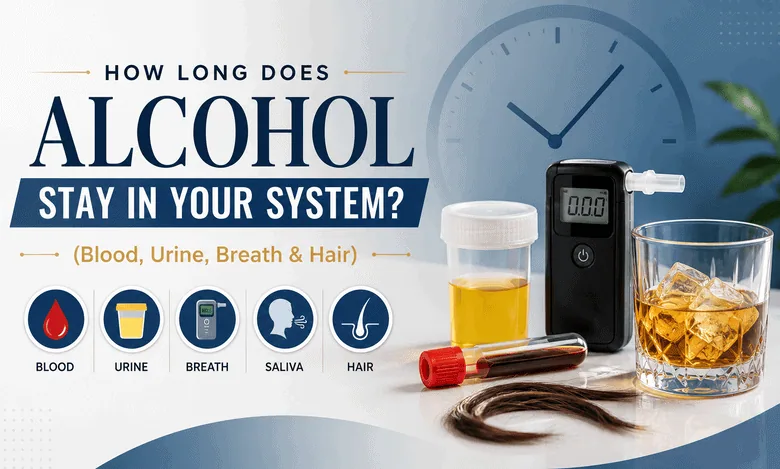
How Long Does Alcohol Stay in Your System? (Quick Detection Times)
| Test Type | Standard Detection Window | Heavy Drinking Window |
| Blood | 6–12 Hours | Up to 24 Hours |
| Breath (Breathalyzer) | 12–24 Hours | Up to 24 Hours |
| Urine (Standard Test) | 12–24 Hours | Up to 24 Hours |
| Urine (EtG Test) | 24–48 Hours | Up to 72–80 Hours |
| Saliva | 12–24 Hours | Up to 24 Hours |
| Hair Follicle | Up to 90 Days | Up to 90 Days |
Note: Detection times are estimates and can vary based on how much you drank, your metabolism, liver health, body weight, medications, and the type of alcohol test used.
How Your Body Actually Breaks Down Alcohol
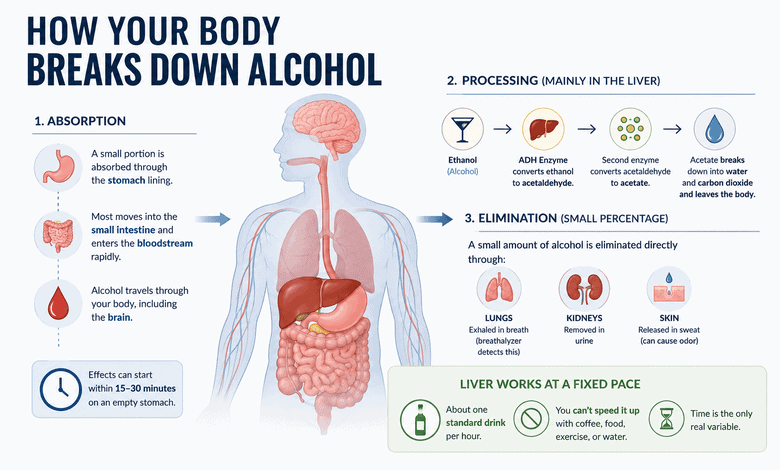
When you drink, alcohol does not go through the same digestive process as food. A small portion is absorbed directly through the stomach lining, but most of it enters the small intestine, where it rapidly enters the bloodstream. From there, it travels through your body, including your brain, which is why effects can start showing up within 15 to 30 minutes of your first drink on an empty stomach.
The liver is where most of the actual processing happens. An enzyme called alcohol dehydrogenase (ADH) converts ethanol into acetaldehyde. A second enzyme then breaks acetaldehyde down further into acetate, which eventually leaves the body as water and carbon dioxide. Your lungs, kidneys, and skin also eliminate a small percentage directly, which is why a breathalyzer can pick up alcohol in the air you exhale and why someone who has had a lot to drink sometimes smells like it even through their skin.
The critical thing to understand is that your liver works at a fixed pace. For most adults, that rate is roughly one standard drink per hour. You cannot push it faster by drinking coffee, eating a big meal, working out, or drinking more water. The pace is what it is, and the only real variable is time.
What One Standard Drink Actually Means
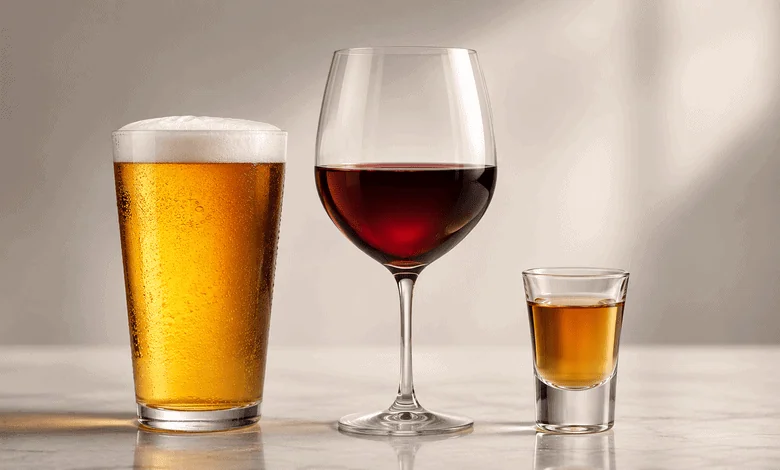
The reason people underestimate how long alcohol stays in their system is almost always because they underestimate how much they actually drank. This matters a lot.
In the United States, one standard drink is any beverage containing around 14 grams of pure alcohol. In practice, that is roughly a 12-ounce regular beer at 5% ABV, a 5-ounce glass of wine at 12% ABV, or a 1.5-ounce shot of distilled spirits like vodka, whiskey, rum, gin, or tequila at 40% ABV.
The issue is that real life rarely matches those measurements. A wine glass filled generously at home can easily hold 8 or 9 ounces, which is nearly two drinks in one glass. A craft IPA sitting at 8% ABV is almost double a standard drink on its own. A bartender with a heavy hand on the pour can put two or three drinks’ worth into a single cocktail. When you are trying to figure out how long alcohol will stay in your system, it is the actual number of standard drinks that matters, not the number of glasses or bottles.
Understanding Blood Alcohol Concentration
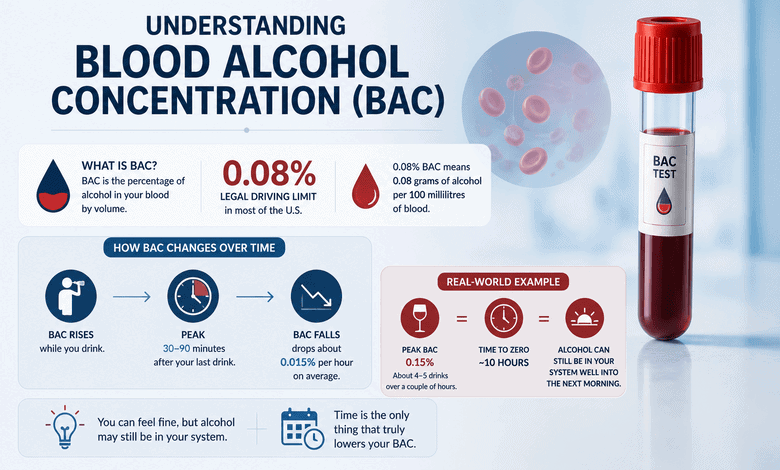
When tests measure alcohol in your system, they are measuring blood alcohol concentration, or BAC. This is the percentage of alcohol in your blood by volume. A BAC of 0.08%, the legal driving limit across most of the United States, means there is 0.08 grams of alcohol per 100 millilitres of blood.
BAC rises while you drink and falls as your liver processes the alcohol. It typically peaks somewhere between 30 and 90 minutes after your last drink, which means you can still feel increasingly intoxicated even after you stop drinking. After that peak, it drops at approximately 0.015% per hour on average.
To put that in real terms: if you hit a peak BAC of 0.15%, which is roughly double the legal driving limit and achievable with four or five drinks over a couple of hours, it would take about ten hours for your blood to return to zero. That puts alcohol still in your system well into the next morning, even if you feel completely fine.
How Long Does Alcohol Stay in Your Blood
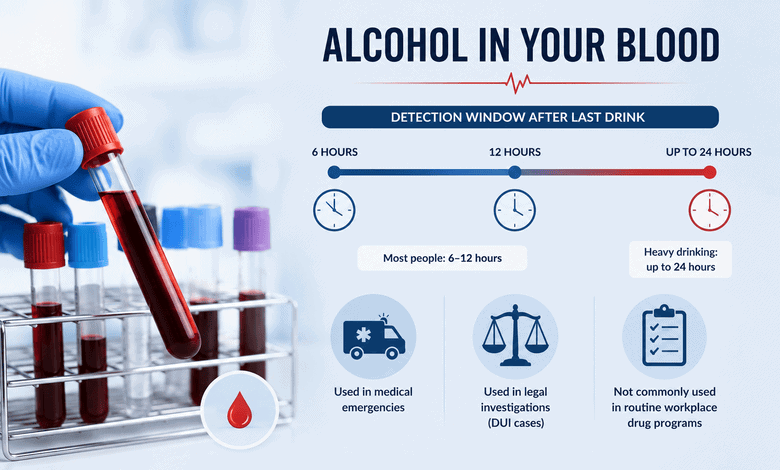
A blood test measures actual alcohol concentration in your bloodstream, making it one of the most accurate methods for detecting current intoxication. The detection window is shorter than most people expect, because your liver is continuously clearing the alcohol as it circulates.
For most people, alcohol remains detectable in blood for 6 to 12 hours after the last drink. After a heavier night of drinking, some sources place this window closer to 24 hours. Blood tests are most commonly used in medical emergencies and legal investigations like DUI cases rather than routine workplace drug programs, largely because of how quickly the detection window closes.
One important distinction: a blood test is measuring the alcohol itself, not a metabolite. Once your liver finishes processing it, there is nothing left to detect. That makes it fundamentally different from an EtG urine test, which we will get to shortly.
How Long Does Alcohol Stay in Urine
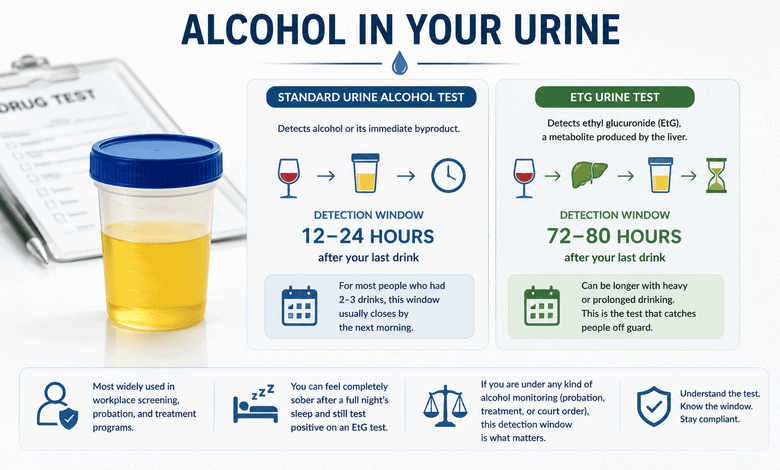
Urine testing is the most widely used method in workplace screening, probation monitoring, and addiction treatment programs, and there are two very different types of tests with very different detection windows.
A standard urine alcohol test looks for either alcohol itself or its immediate byproduct. This test can detect alcohol for roughly 12 to 24 hours after your last drink. For someone who had two or three drinks the night before, this window typically closes by the next morning.
The EtG test is a different situation entirely. EtG stands for ethyl glucuronide, a metabolite the liver produces while breaking down alcohol. It gets excreted through urine and lingers long after the alcohol itself has been fully cleared. An EtG urine test can detect evidence of drinking for 72 to 80 hours after the last drink, and in some cases of heavy or prolonged drinking, even longer than that.
This is the test that catches people completely off guard. You can feel stone-cold sober, sleep a full eight hours, wake up the next morning, and still produce a positive EtG result, especially if you had a heavy night. If you are subject to any kind of alcohol monitoring, whether through probation, a treatment program, or a court order, this is the detection window that actually matters.
Does the Type of Alcohol Change the Urine Detection Window
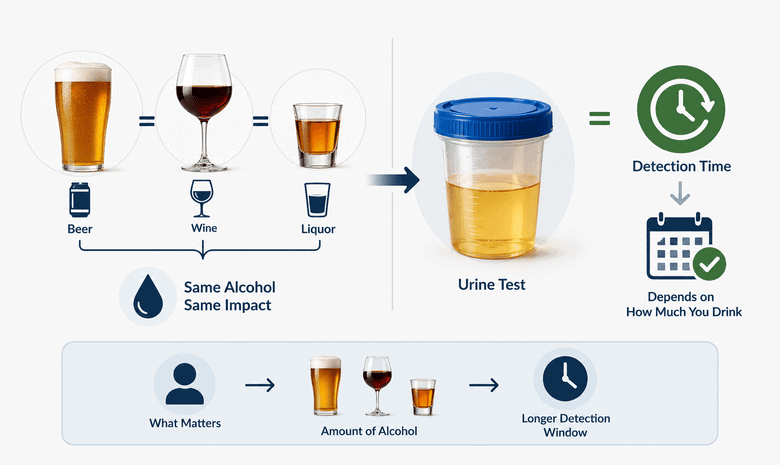
People frequently want to know whether beer, wine, liquor, or shots clear differently in urine. The short answer is that the type of beverage is almost irrelevant. What matters is how many standard drinks worth of alcohol you consumed. A shot of tequila, a can of beer, and a glass of wine all carry roughly the same amount of alcohol and will produce similar detection windows.
Where the type of drink sneaks in as a factor is in how easy it makes it to accidentally consume more than you realized. Two pints of a strong craft beer might equal four or five standard drinks. A generous pour of wine might be nearly two drinks in a single glass. The harder it is to accurately track your intake, the longer alcohol is likely to stay detectable.
A Note on Alcohol in Urine for Monitoring Programs
If you are on a monitoring program and were told you need to stay alcohol-free, the EtG test is almost certainly what they are using. Drinking even a moderate amount on a Friday night can still show up in a Monday morning test. This is not a flaw in the test. It is exactly what it was designed to do.
How Long Does Alcohol Stay in Your Breath
A breathalyzer measures the alcohol in the air you breathe out. Because a small fraction of alcohol exits the body through the lungs rather than being processed by the liver, your breath can still test positive for alcohol roughly 12 to 24 hours after your last drink, depending on how much you consumed.
Breathalyzers measure what is called breath alcohol concentration, and this reading closely mirrors BAC. That direct relationship is exactly why law enforcement relies on them for roadside testing.
Like blood tests, breathalyzers are measuring the alcohol itself rather than a lingering metabolite, so the detection window closes when the alcohol clears. The bigger the night, the longer that takes.
To put some numbers to it: two standard drinks raise the average person’s BAC by roughly 0.03 to 0.04%. Falling from that level to zero takes about two to three hours. So two drinks from the night before almost certainly will not register on a breathalyzer the next morning. Six or eight drinks over a few hours is a completely different story.
How Long Does a Breathalyzer Detect Alcohol
A breathalyzer can typically detect alcohol for up to 12 to 24 hours after drinking. Whether you fall closer to the 12-hour end or the 24-hour end depends primarily on how much you drank and how efficiently your body metabolizes alcohol.
The question of how long a breathalyzer can detect alcohol also depends on the device itself. Personal breathalyzers vary in sensitivity and accuracy. Law enforcement-grade devices used on the roadside are calibrated to very specific standards.
How Long Does Alcohol Stay in Saliva
Saliva testing is less common than urine or breath testing, but it is sometimes used because it is non-invasive and produces quick results. The detection window is similar to a breath test, around 12 to 24 hours after the last drink. Saliva tests detect alcohol directly rather than a metabolite, which means the window is tied to how long alcohol stays in the bloodstream.
How Long Does Alcohol Stay in Your Hair
Hair follicle testing operates on an entirely different timeline than every other method. As your hair grows, it incorporates traces of compounds that were circulating in your bloodstream during that period of growth. For alcohol, the relevant metabolites are EtG and fatty acid ethyl esters, sometimes abbreviated as FAEEs. A hair sample can show evidence of drinking that occurred up to 90 days before the test.
This method is not built to detect whether someone had a drink last Saturday. It is built to reveal a pattern of drinking over months, which is why you mostly see it in legal proceedings, custody cases, and certain professional licensing decisions rather than standard workplace testing.
What Affects How Long Alcohol Stays in Your System
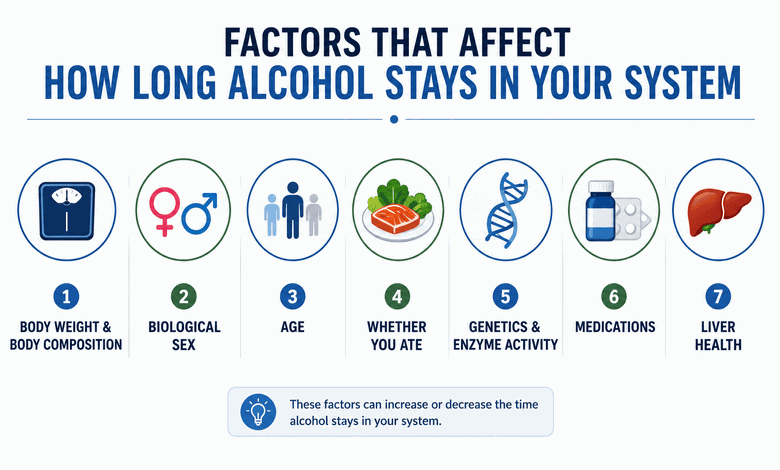
The one drink per hour average is a useful starting point, but individual variation is real and sometimes significant. Several factors can push your actual clearance time noticeably higher or lower.
Body Weight and Body Composition
Alcohol distributes itself in the water content of your body. A larger person generally has more total body water, which means the same amount of alcohol gets diluted more, resulting in a lower peak BAC. A 130-pound person and a 200-pound person drinking the same drinks will not hit the same BAC or clear alcohol at the same rate.
Body composition also plays a role beyond just the number on the scale. Fat tissue does not absorb alcohol the way muscle and other tissues do. Two people at the same body weight but different ratios of muscle to fat can have meaningfully different BAC levels from the same intake.
Biological Sex
On average, women have a higher percentage of body fat and lower total body water than men of similar weight. That means alcohol is less diluted in a woman’s body, and the same number of drinks produces a higher BAC. Women also tend to produce less ADH in the stomach lining, which means more alcohol reaches the bloodstream directly before the liver even starts processing it.
These are population-level averages and individual variation exists, but they explain why alcohol recommendations often differ between men and women, and why blood alcohol content after one beer or after multiple drinks can differ between sexes even when body weight is similar.
Age
The body’s water content decreases, and metabolism naturally slows with age. Older adults process alcohol more slowly and may reach higher BAC levels from the same amount of drinking compared to when they were younger. Liver enzyme activity also tends to decline with age, which extends clearance time. On the other end, teenagers and young adults metabolize alcohol unpredictably and are more vulnerable to its cognitive effects even at relatively low BAC levels.
Whether You Ate
Eating before or while drinking is probably the single most useful behavioural factor in how alcohol affects your system. Food, particularly protein, fat, and fibre, slows gastric emptying, which keeps alcohol from rushing into the small intestine and bloodstream as quickly. This reduces and delays your peak BAC significantly.
The important caveat: this only works during the absorption phase. Once alcohol has already entered your bloodstream, food does essentially nothing to speed up elimination. Eating a heavy meal after you have been drinking for hours will not help you clear alcohol faster. The benefit of food is almost entirely front-end.
Genetics and Enzyme Activity
Some people carry genetic variants in the genes that produce ADH and ALDH, the two enzymes most involved in alcohol breakdown. Slower ADH variants mean slower processing overall. Faster variants mean quicker clearance. The alcohol flushing response, where someone’s face turns red and their heart races after just one or two drinks, is often caused by a genetic variant more common in people of East Asian descent. This variant causes acetaldehyde, the toxic intermediate product in alcohol metabolism, to accumulate faster than the body can clear it. People with this variant often have a genuinely different relationship with alcohol tolerance and metabolism.
Medications
A surprisingly long list of common medications interact with how alcohol is processed in the body. The antibiotic metronidazole is a well-known example. Certain antifungals, some antidepressants, antihistamines, and various blood pressure medications can all alter how alcohol behaves in your system or amplify its effects at lower doses. If you take regular prescription medication, a quick check with your pharmacist about alcohol interactions is genuinely worth doing.
Liver Health
Your liver does roughly 90 to 95% of the work when it comes to metabolizing alcohol, so its condition matters a lot. Chronic heavy drinking causes progressive liver damage over time, and a damaged liver processes alcohol more slowly even as tolerance to alcohol’s effects increases. People with hepatitis, fatty liver disease, or cirrhosis can take significantly longer to clear alcohol than someone with a healthy liver, which also changes how long alcohol shows up in blood tests and other screening methods.
How Long Do the Effects of Alcohol Last
The feeling of being drunk and the presence of alcohol in your system are closely linked but not identical. Intoxication generally tracks with BAC, though tolerance changes how intensely you feel it at any given level.
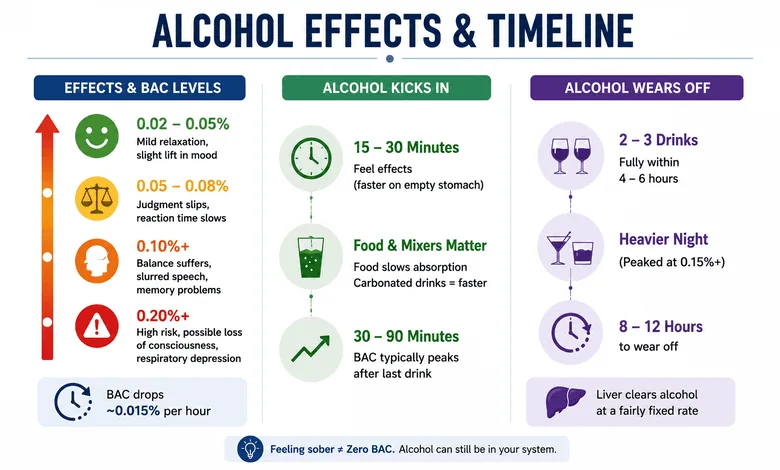
At a BAC around 0.02 to 0.05%, most people notice mild relaxation and a slight lift in mood. Between 0.05 and 0.08%, judgment begins to slip and reaction time slows even though many people at this level feel confident they are fine. At 0.10% and above, the effects become hard to miss: balance suffers, speech can slur, short-term memory starts breaking down. Above 0.20%, the situation becomes genuinely dangerous, with risk of losing consciousness, inability to protect the airway if vomiting occurs, and, at the end, respiratory depression.
Since BAC drops at roughly 0.015% per hour, you can work backward from your estimated peak to get a rough sense of how long drunkenness will last. But feeling sober and having a zero BAC are not always the same thing, particularly for people with enough tolerance that they feel normal well before alcohol has actually cleared.
How Long Does It Take Alcohol to Kick In
Most people begin feeling the effects within 15 to 30 minutes of drinking, and faster on an empty stomach. How long it takes for alcohol to hit depends on absorption speed, which is slowed by food and accelerated by carbonated drinks (like mixing spirits with soda). BAC typically peaks somewhere between 30 and 90 minutes after the last drink, meaning you can still feel increasing effects even after you stop.
How Long Does It Take for Alcohol to Wear Off
This depends almost entirely on how high your BAC got. Since the liver clears at a fairly fixed rate, the higher the peak, the longer it takes to wear off. Two or three drinks might leave your system fully within four to six hours. A heavier night where you peaked at 0.15% or higher can mean alcohol is still affecting your body eight to twelve hours later, even if you feel relatively normal.
How Long After Drinking Is It Safe to Drive
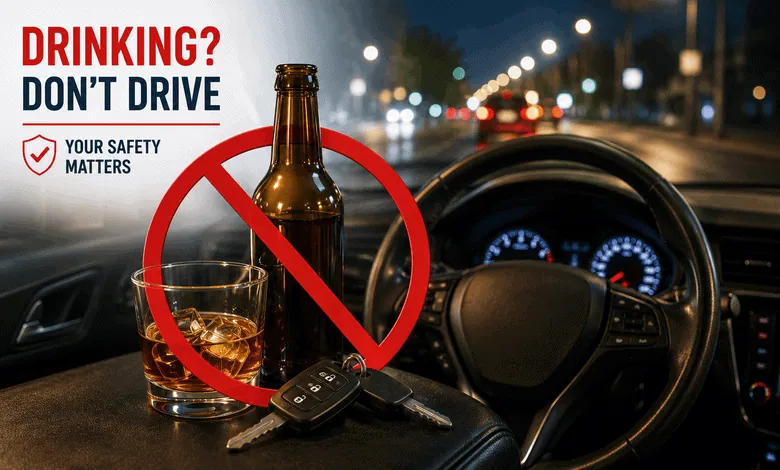
This is the most practically important question this guide can address, so here is the most honest answer possible: there is no reliable formula that tells you when it is safe to drive.
The 0.08% legal limit is a legal threshold, not a safety line. Research consistently shows measurable impairment starting around 0.04 to 0.05% BAC, well under what is legally considered drunk. Reaction time, peripheral vision, and decision-making are all affected before most people feel impaired.
The only genuinely safe rule is this: if you have been drinking, do not drive. Plan, use a rideshare, call someone, or stay where you are. If you must estimate, give yourself at least one hour per standard drink after your last drink, add extra time if you were still drinking in the last hour or two, and use a personal breathalyzer if you have one. Even then, being under the legal limit does not mean you are unimpaired.
Can You Clear Alcohol from Your System Faster
The honest answer is no, not in any way that meaningfully changes the timeline. Your liver processes alcohol at a fixed physiological rate, and there is nothing you can eat, drink, inject, or do that changes that rate in any significant way.
Drinking water keeps you hydrated and may help reduce how rough a hangover feels, but it does not change your BAC. Coffee and energy drinks make you feel more awake, which can actually make the situation worse by creating a false sense of sobriety. This is sometimes called the wide-awake drunk problem, and it has contributed to real accidents where people felt alert but were still meaningfully impaired. A cold shower changes your alertness, not your BAC. Exercise may increase metabolic rate slightly in some research, but the effect is modest and does not translate to passing a test meaningfully earlier.
Detox drinks marketed to help you pass alcohol tests faster have no credible clinical evidence supporting their claims. Some may dilute urine enough to lower the concentration of detected metabolites, but most modern alcohol testing programs screen for dilution specifically and flag samples that appear artificially diluted.
When people search for how to get alcohol out of your system faster, or how to flush alcohol out, or how to clean alcohol out of your system, the answer is always the same: time is the only reliable method. Everything else is managing symptoms, not changing the underlying biology.
Alcohol Poisoning: Signs and What to Do
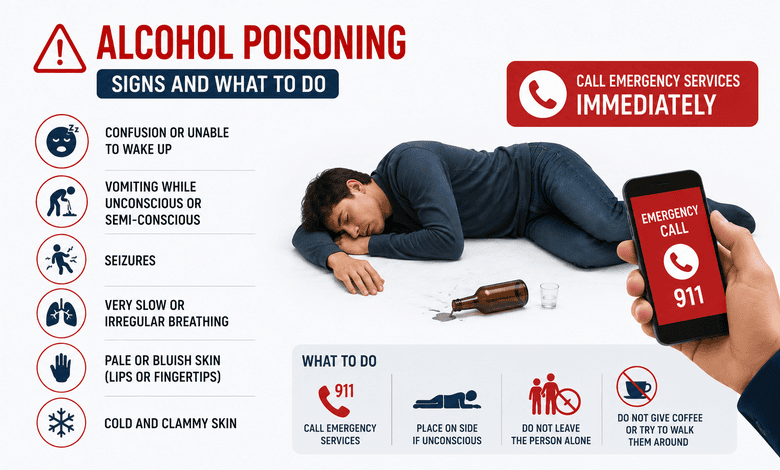
Drinking too much too fast can push beyond what the body can handle, causing alcohol poisoning. This is a medical emergency, not something to sleep off or wait out.
Signs include confusion or inability to wake the person up, vomiting while unconscious or semi-conscious, seizures, very slow or irregular breathing, skin that appears pale or has a bluish tint around the lips or fingertips, and skin that feels cold and clammy. If you see any of these signs in someone, call emergency services immediately. Do not leave the person alone. If they are unconscious, position them on their side to reduce the risk of choking on vomit. Do not try to walk them around or give them coffee. Neither helps.
When Alcohol Use Becomes a Concern
Most people reading this are asking because they had a night out and want to know when they are in the clear. That is completely understandable.
But sometimes the question comes up more frequently than it used to, because tracking detection windows has started to feel like a regular thing rather than an occasional one. If you find yourself regularly drinking more than planned, thinking about alcohol often, or experiencing stress around testing and driving decisions, it may be worth talking to a doctor.
Effective, evidence-based treatment exists, including effective treatments for opioid addiction, medication-assisted approaches, behavioural therapy, and outpatient rehab programs. They work better than most people expect, and asking for help earlier almost always leads to better outcomes.
Frequently Asked Questions
How long does alcohol stay in your system for a urine test?
A standard urine alcohol test detects alcohol for 12 to 24 hours after drinking. The more sensitive EtG urine test, which is commonly used in monitoring programs, extends that window to 72 to 80 hours, sometimes longer after heavy or sustained drinking.
How long does one beer stay in your system?
A single 12-ounce beer at 5% ABV is one standard drink. It will generally clear from your blood within one to two hours. In urine, it may still show up on a standard test for up to 12 to 24 hours.
How long does wine stay in your system?
A standard 5-ounce pour of 12% wine is one drink and leaves the system at the same pace as beer or spirits. The detection window in urine is 12 to 24 hours on a standard test, up to 72 to 80 hours on an EtG test.
Does drinking water flush alcohol out of your system?
No. Water helps prevent dehydration and may ease hangover symptoms, but it does not speed up the liver’s ability to metabolize alcohol or change how soon you will pass a test.
How long after drinking can a breathalyzer detect alcohol?
Typically 12 to 24 hours, depending on how much you drank. Two standard drinks will clear from your breath within a few hours. A heavy night of drinking may still register on a breathalyzer the following morning.
How long does alcohol stay in your blood?
Alcohol is detectable in blood for approximately 6 to 12 hours after the last drink. After heavier drinking sessions, this can extend to around 24 hours.
How long does alcohol stay in your hair?
Up to 90 days. Hair testing reveals patterns of drinking over months, not individual episodes.
How long does alcohol stay in saliva?
Approximately 12 to 24 hours after the last drink.
How long does it take to feel the effects of alcohol?
Most people notice effects within 15 to 30 minutes. BAC peaks 30 to 90 minutes after the last drink, meaning you can still feel increasing intoxication even after stopping.
How long does drunkenness last?
It depends on how much you drank. Since BAC drops at roughly 0.015% per hour after peaking, someone who hits 0.12% might feel meaningfully intoxicated for six to eight hours. Feeling sober can happen before BAC actually reaches zero, particularly in people with higher tolerance.
How long does it take to metabolize alcohol?
Roughly one standard drink per hour for most adults. This rate is fairly fixed and cannot be meaningfully sped up.
How long does it take for alcohol to kick in?
Effects typically begin within 15 to 30 minutes, faster on an empty stomach. Carbonated mixers can accelerate absorption slightly.
How long does it take for alcohol to wear off?
Depends on peak BAC. At 0.015% per hour clearance, someone at 0.10% would take roughly seven hours to reach zero. Someone at 0.15% would need about ten hours.
How long does it take the liver to process alcohol?
The liver processes roughly one standard drink per hour. Nothing meaningfully speeds this up.
How long does alcohol last in your system?
Depending on the test: blood up to 12 to 24 hours, breath up to 24 hours, standard urine up to 24 hours, EtG urine up to 80 hours, hair up to 90 days.
Alcohol half-life?
Alcohol does not follow a true half-life the way many drugs do because the liver processes it at a relatively constant rate rather than a percentage-based rate. That rate works out to approximately 0.015% BAC per hour, or roughly one standard drink per hour.
How many days does alcohol stay in your system?
For blood and breath: usually no more than one day. For EtG urine testing: up to three days after moderate drinking, potentially longer after heavy or daily drinking. Hair testing: up to 90 days.
How long does alcohol stay in the body?
The alcohol itself clears from blood within 6 to 24 hours, depending on quantity. Metabolites detectable in urine can linger for up to 72 to 80 hours. Hair can hold evidence of alcohol use for up to 90 days.
This article is for informational purposes only and does not constitute medical advice. If you have questions about alcohol metabolism, drug testing, or concerns about alcohol use, please consult a licensed healthcare provider.